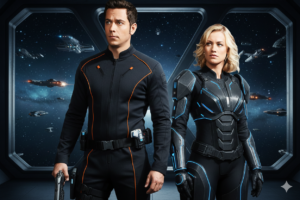
Chapter 16
The Quiet Before the Plan
The beacon kept pulsing in my head like a wound I couldn’t stop touching.
I sat in the pilot’s chair long after the jump completed, waiting to be brought in the resistancebase, hands still on the controls though the shuttle no longer needed me. The cabin lights were dimmed for long-range travel; the others pretended sleep. I could not. The pattern—three short, one long, two short—replayed behind my eyes like a private metronome. It was a map and a promise and a plea.
Casey watched me for a long minute without saying anything. He’d seen the way the bond had snapped when we were talking and the signal appeared, the way Sarah’s presence had gone cold like a door slammed shut. He’d seen me break and then put myself back together enough to plan. That steadiness was why I trusted him.
“We have a signature,” I said finally. My voice sounded small in the hush, like a radio ping in a cavern. “It’s faint. It’s smeared. But it’s hers. It’s coming from the Reaper’s Lord sector—near their transport lanes.”
Casey’s jaw tightened. “You sure?”
“As sure as I can be.” I pushed the beacon across the console and let the nav bloom the ghostly vector. A pale line traced itself across the map, a direction more than a destination. “She’s on a ship.”
The words landed and the cabin went colder. He didn’t need to be told what that meant. We both felt the same ice: she was alive and in immediate danger.
“We can’t just fly in,” Casey said. “We don’t have the firepower.”
“No.” I rubbed my ribs where the old pain still flared, a useless, human reminder that I was not invincible. “We don’t. But we have a thread. We have a place to start.”
He nodded. “Then we start smart. We gather. We don’t rush.”
I wanted to argue. I wanted to throttle the hesitation out of him and launch into the dark. Instead something else rose up—an animal panic that had nothing to do with tactics. Time had become a rumor. The bond that used to steady me was gone, a snapped wire I could no longer follow. There was no warm hum to guide my hands, no faint pressure at the edge of thought telling me where she might be. The silence where she had been felt like a wound.
I could feel the panic in my throat, a dry, hot thing that made my hands shake on the console. I imagined the worst in a dozen quick flashes: crates, clamps, cold lights, her face half hidden by blood and metal. I imagined the mothership’s racks humming and her name being used as a signal. I imagined time slipping away—minutes folding into hours, hours into a decision I might never get to make.
Love is not a map, I told myself. It is not a sensor. It is not a failsafe. But it is a reason.
I thought of the station plaza fight, the way she’d said “Live” like an order and a benediction. Those memories were small, private, and stubborn. They were not the bond, but they were ours. They were enough to make my hands steady.
“Listen,” I said, voice rough. “We don’t have the fleet. We don’t have time to wait and hope the mothership makes a mistake. We have a vector and a thread. We have people who will move if we give them a reason. We make that reason impossible to ignore.”
Casey watched me for a long second, the kind of look that measures whether a man is breaking or forging. I felt the rawness in my chest—fear braided with something harder. I let the fear be fuel.
“Then we start smart,” he repeated. “We gather. We don’t rush.”
“No,” I said, and this time the word was a promise. “We move. We make it count.
I pulled up the encrypted channels and sent the beacon signature to every relay station we could reach. I attached the courier’s beacon pattern and a short, brutal message: Walker Blade captured. Location: Reaper’s Lord transport lanes. Need assets. Now.
The replies came in trickles and then in a flood: a corvette that could make the run but not linger; a stealth drone with a busted sensor array that could still listen; a handful of volunteers who owed us favors or just hated The Reaper’s Lord. It wasn’t much. At the same time, it was everything.
When the last ping faded, Casey leaned back and let out a breath that sounded like a plan forming. “We’ll take what we can get. This is our only shot.”
I closed my eyes and let the bond’s memory echo—faint, stubborn—answer me? She had given me a place to look. I would not waste it.
The Debrief
The resistance command sat carved into the shadow of an asteroid like a wound patched with light. Corridors funneled into a single, humming chamber where holo maps crawled with vectors and manifests scrolled in thin green type. Consoles blinked; cables looped like veins. The air smelled of solder and reheated coffee. Faces around the table were tired and sharp, the kind of faces that had learned to measure risk in breaths.
We came in like a rumor, Devon, Morgan, Casey, and I. The corvette’s ramp folded behind us, and the room turned—eyes, heads, the small, precise silence that happens when a plan becomes a person. I laid the courier beacon on the table and watched the room read it like scripture. The little device looked ridiculous and holy all at once: a scrap of metal and wire that had become a lifeline.
General Beckman stood at the head of the table. She was shorter than the legends made her in the field, but her presence filled the room—steel wrapped in a voice that had given orders through worse than this. Her uniform was patched, her jaw set. “You found a needle in a storm,” she said without surprise. “That’s good. That’s dangerous. That’s also a trap.”
“We know it’s a trap,” Casey said. His voice was flat, the kind of flat that comes from a man who’d learned to keep his face even when the world was breaking. “We also know it’s Sarah.”
A younger scout commander—Zondra Rizzo—tapped the display and the map zoomed in on a corridor of moving signatures. “Transport lanes are ringed with patrols. The Reaper’s Lord escorts are adaptive. If we push in, we’ll be fighting a fleet.”
“We’re not pushing a fleet,” I said. My hands moved on the console as if the motion could steady the tremor in my chest. “We’re threading a needle. We use the courier’s beacon to triangulate. We use the corvette as bait—draw attention, then slip a stealth team in on the flank. We hit the transport, extract what we can, and get out before they can reconfigure.”
General Beckman’s eyes narrowed. “You’re asking me to risk a corvette and volunteers on a ghost of a signal.”
“I’m asking you to risk what we can afford to lose to save what we can’t replace,” I said. The words came out raw. “Sarah isn’t a piece of hardware. She’s the person who inspired me to use my potential to see seams. She’s the reason a lot of people are still breathing.”
Silence settled like dust. Then Beckman’s hand closed into a fist on the table. “You’re reckless,” she said. “You’re also right. We’ll spare the corvette. We’ll spare the drone. But we go in with a plan and an exit. No heroics.”
“No heroics,” I echoed, and meant it. Heroics had gotten us this far and nearly cost us everything. This time, we would be surgical.
Zondra’s face went harder. She pulled up an intercepted manifest, and the room leaned in. “We intercepted a manifest,” she said. “The transport isn’t just carrying parts. It’s a mobile processing node—modular, shielded, and designed to offload live cargo into the Reaper Lord’s fleet. If Sarah’s on board, she’s not just a prisoner. She’s a relay. They could be using her to amplify Fulcrum’s control.”
The temperature in the room dropped a degree. The idea of Sarah turned into a tool made the air taste metallic.
“If that’s true,” Beckman said, voice low, “we don’t just extract. We cut the node out.”
The weight of the decision landed in my gut like a physical thing. Cut the node out—destroy the evidence, free any prisoners, but risk killing those inside. Extract the node intact—save the people and the proof, but give Fulcrum time to react.
“We’ll do both if we can,” I said. “We’ll prioritize people. We’ll prioritize Sarah.”
Beckman’s eyes met mine and held. “Then we prepare.”
Small Human Things
We’d barely finished the briefing when Casey’s shoulder tensed. He’d been a machine all morning—focused, efficient—but something in the doorway made him go still. I followed his line of sight and saw a young woman standing half hidden by a stack of crates: Alex, Casey’s daughter, he mentioned a few weeks ago on Bespin Spire. Weeks that seemed like years. She was older than the last time I’d seen her in a holo—longer hair, a small scar at the brow, eyes that had learned to measure danger and still keep a sliver of mischief.
Casey’s face changed in a way I’d never seen before—gruff, guarded, like a man trying to keep a tide from breaking. He grunted, an animal sound that was almost a laugh and almost a sob. He fought it down, the way he always fought the soft things that wanted to get in. For a second he looked like he might turn away, like the old rules of command would keep him from being a father in front of everyone.
Alex stepped forward anyway. She crossed the room in two strides and launched herself at him. Casey’s first reaction was to stiffen, then to wrap his arms around her like he’d been holding that space empty for years. He grunted again—this time a sound of surrender—and his face went wet and fierce. He tried to be a soldier, but the soldier melted into a man who had been given back a piece of himself.
“Dad,” Alex said, voice small and fierce.
“Alex,” Casey answered, voice breaking the way a man’s voice does when he’s been holding too much. He let her go and then pulled her back, fingers rough on her shoulder. “You—how—”
“I’m with a salvage crew,” she said. “Been running with them since the ship I was in got attacked by those horrible converts. I heard the beacon. I had to come.”
Casey’s jaw worked. He grunted, a sound that was half apology, half gratitude. He fought the softness in his eyes like it was a thing he could deny, but it leaked out anyway. He kissed her forehead—quick, clumsy, utterly human—and the room shifted around that small, private thing.
A Ray of Sunshine Between the Clouds
For a beat, the command room held its breath, the maps and manifests and hard faces folding around that quiet, ordinary tenderness. Alex stayed pressed to him, then eased back and scanned the room as if checking the horizon for threats. Her eyes caught on Morgan before anyone else’s—he was the one who never quite looked like he belonged in a war room, leaning against a console with a half smile and a pocket full of ridiculous comforts. The sight of her made him straighten in a way that was almost comical: posture sharpening, grin widening, the practiced ease of someone who could turn any stranger into a friend.
Morgan crossed the short distance with the casual confidence of a man who’d learned charm was a useful tool, at least his version of charm. He offered a hand and a ridiculous, immediate compliment about her scar—“battle chic,” he called it—and Alex blinked, surprised, then laughed, the sound bright and quick enough to cut the tension. The laugh loosened something in Casey’s shoulders; he watched them with a look that was equal parts relief and suspicion, the way a father watches a sparring partner test his kid.
Morgan didn’t stop at a joke. He produced a pack of instant coffee and a tin of smuggled chocolate like a peace treaty, setting them on a crate between them. Alex accepted the tin with a small, guarded smile, and the two of them fell into the easy rhythm of people who survive by talking too much—Morgan’s exaggerated near misses, Alex’s salvage runs, the absurd little victories that keep you human. Their voices braided into the room’s hum, and for a few minutes the plan laden air thinned.
Casey stayed close enough to see, close enough to step in if needed, but not so close that he smothered the moment. He grunted again—this time softer—and let himself watch the sparks that had nothing to do with weapons. When Morgan handed Alex the tin, Casey stepped a fraction closer, his voice dropping until it was a rough whisper meant for Morgan alone.
“You hear me, bearded gnome?” he growled, gravel and warning braided together. “You keep my girl happy and safe, you hear? One screw up, and you’ll be answering to me.”
Morgan’s grin didn’t falter. He gave a mock salute, the tin held like a peace treaty. “Scout’s honor,” he said, and Alex rolled her eyes, but the smile on her face stayed.
A First Meeting and a Promise
Near the back of the room, a young blond girl sat on a crate with her knees pulled up. I recognized her from Sarah’s memory, the girl she saved. At the time, I didn’t press the matter, but now I understand. She was small, maybe 8 years old, with a face that still held the rawness of someone who’d been saved and not yet healed. Sarah had found her in the Reaper’s Lord base, wrapped her in a blanket, and told her to keep breathing. The little girl’s eyes tracked me when I moved; there was fear in her eyes, even safe in the base, the trauma didn’t let her be a child.
I crouched down beside her. She flinched at first, then let the flinch go when she saw my face. Her hands were small and callused in a way that made me think of the people who work with their hands to keep a life together.
“You okay?” I asked, stupidly small. “What’s your name?”
The girl whispered, “Molly.” Her voice came out thin. “Sarah saved me,” she said. The words were simple and enormous. “I thought that she would be here with the new arrivals.”
“You remember her,” I said because I needed to hear it aloud.
Molly’s eyes filled. “She hummed a song,” she whispered. “She said not to be afraid. She said to keep breathing.” Her fingers found the edge of the blanket and twisted it like a talisman.
Those words landed like a small, holy thing. The bond that used to steady me was gone; there was no warm filament to follow. But the memory she shared with me—Sarah’s hands, her voice, it was like she shoved Molly into my arms and we saved her together—was a different kind of tether. It wasn’t a signal. It was a promise.
I put my hand over hers. My palm was big and rough; hers was small and stubborn. The contact was ordinary and enormous.
“I’m Chuck,” I said. “I know Sarah. I—” My throat closed. I let the sentence hang and then finished it differently. “I’ll do everything I can to find her and bring her back.”
Molly’s breath hitched. She looked at me like she was testing whether the promise would hold. “Will you?” she asked, the single word a child’s litmus test.
“Yes,” I said. The word felt like a stone I set down between us. “I promise.”
Before I left, she asked, voice small and urgent, “Tell me something funny about her.”
I smiled despite myself. I said. “She stole some chocolate croissants that I got from my friend Morgan. Pretended she didn’t love them so much.”
Molly laughed—bright and surprised—and the sound felt like sunlight. It was a small victory and a weapon against the dark.
When I stood, I kept my hand on Molly’s shoulder a beat longer than necessary. The bond might be broken, but the people Sarah had touched were not. They were a chain. They would be the hands that pulled her back.
The Room Reorients
General Beckman watched the small reunions with a soldier’s patience. She let the human moments happen—Casey’s rough tenderness, Morgan’s easy charm, my promise to Molly—then folded them back into the work at hand.
“We have volunteers,” she said, voice like a blade wrapped in cloth. “We have a corvette and a stealth ship that can be pressed into service. We have a drone with a busted sensor array that can still listen. We have one narrow window to act before the transport docks or the mothership integrates the node.”
Zondra’s fingers flew across the console and the map tightened. “If we cut the node out, we risk lives inside the ship. If we extract intact, we risk the node being moved deeper into the fleet.”
Beckman’s eyes met mine. “You said you’d prioritize people.”
“I did,” I repeated the same answer. “We’ll prioritize people if we can. We’ll prioritize Sarah.”
She nodded once, the motion final. “Then we prepare. You’ll have what you need—within reason. No single ship will be sacrificed without a plan. No heroics.”
I looked at the faces around the table—Morgan, Devon, Casey, Zondra—and felt the weight of the promise again. The beacon was a thread. The people in this room were the hands that would pull it. Love had become our reason; it would have to be our strength. Those are the volunteers, the stealth team that would enter the belly of the beast and bring Sarah back.
“Then we prepare,” I repeated. The words were steadier now. The panic that had been a hot thing in my throat cooled into a hard, bright resolve. We would move. We have to be perfect.
Preparation
Preparation was a montage of small, precise violence: rewiring, recalibrating, and rehearsing the impossible.
Casey and I worked the corvette’s systems until the old ship hummed like a beast waking. Morgan and a pair of volunteers stripped the stealth ship and drone down and rebuilt its sensor array with scavenged parts. I rewired the drone’s receiver to listen for the courier’s beacon pattern and fed it a filter that would let us pick the signal out of the Reaper’s Lord’s noise.
Every fix had a cost. The corvette’s shields would only hold for a single burn. The drone’s stealth would be a one-time cloak. The EMP charges we could spare were limited and would fry anything within a tight radius—useful against bioports, lethal to anyone inside a crate.
The stealth ship was renamed “Whisper.” I dedicated all I had to that ship, she was our ticket in to save Sarah.
We ran the drone insertion in the simulator until my hands cramped. We practiced the boarding sequence, the latch and breach, the extraction choreography. We rehearsed contingencies: if the transport moved, if the mothership responded, if the beacon went dark.
Between runs, I sat alone and let the memory of Sarah fill the silence. I traced a fingertip over my chest, feeling the phantom itch of the engraving Sarah had made on her own skin—a mark I could feel through our bond if it was active, as if it were etched into my own flesh, and thought of the way she’d said, “Live.” I thought of the way she’d pushed me away because she loved me enough to be incisive. I thought of the way she’d trusted me to be the thing she needed when she could not be.
Preparation was also confession. I told Casey the truth I’d been holding like a stone: I’d left because she practically ordered me to. I’d obeyed. I’d failed to be at her side, and I’d obeyed. He listened without judgment and then handed me a small, practical thing—a spare power splice he’d soldered himself.
He grunted, “You’re not alone, kid,” he said. “You never were.”
The words were a map as much as the beacon had been.
The Probe
The stealth drone launched before dawn, a dark mote against a bruised sky. I watched the telemetry climb and held my breath as the filter hunted for the courier’s signature.
The first pass returned noise—static and interference and the Reaper’s Lord’s own countermeasures. The second pass found a whisper: a faint carrier, smeared across frequencies, repeating the childish pattern. The drone locked and began to triangulate.
“Vector,” the drone operator said. A line traced itself on the display. It pointed not to a single point but to a corridor of space—transport lanes, moving targets, a cluster of signatures that shifted like a school of fish.
The drone dove closer and the feed stuttered. For a heartbeat the image cleared: a transport, armored and modular, flanked by escort skiffs. Then the feed glitched and the drone’s camera went dark.
“Signal lost,” the operator said.
“Why?” I demanded.
“Countermeasures,” Zondra said. “They’re jamming. The transport’s sensors are adaptive.”
We had a window, but it was closing. The drone’s last ping showed the transport’s vector—heading toward a rendezvous with a larger vessel. If we didn’t move, the transport would dock and the node would be integrated into the fleet.
“We have to move now,” I said.
Beckman’s face was a map of calculation. “We move on my mark. We use the Corvette as bait. The drone will try to reestablish a connection lock and guide the signal hack. We get in, we get out. We get the data we need and act upon the intel.”
I felt the old fear—sharp, immediate—but it was braided now with something else: a plan, a team, a promise.
We launched.
Hitching a Ride
The corvette rode the dark like a blade, its engines a low, impatient growl. We kept to the shadows of the transport lanes, hugging debris and the blind spots the Reaper’s Lord’s sensors left when they were busy chewing through a field of wreckage. The drone pinged ahead, a ghost that listened for the courier’s childish rhythm and tried to pull it out of the noise.
“Lock reacquired,” the operator said, voice tight. “Vector stable. Transport is holding course—heading for rendezvous with a larger vessel.”
“On my mark,” General Beckman said. Her hands were steady. Her face was a map of decisions. “Corvette will make a visible run. Stealth team will cut in on the flank. Drone will guide you to the latch point. You get one shot at the node.”
The corvette flashed its signature like bait. Skiffs peeled off and came hunting. The Whisper’s pods unclipped and drifted toward the transport’s flank—small, dark seeds. The stealth team assembled: Dr. Devon Woodcomb, our medical and bio augmentation expert; Casey, a one-man army; Zondra Rizzo, scout; Morgan and me—an engineer and hacker who could crack a system given time and caffeine. We clipped to the hull and found a maintenance splice point. We did not go wandering through the hold. We didn’t need to.
I fed the drone’s lock into the splice and let the remote interface do the work. The node’s telemetry bled across my console: modular plating, shield coils, racks of processors, a central spine that pulsed with a low, hungry light. Manifest fragments scrolled: BIOPORT ARRAY x12; PROCESSOR RACKS x6; LIVE HOLD FLAGGED.
My hands trembled at the splice. For a second the world narrowed to a small, private memory—Sarah dancing with her blade, a song that was mostly deadly and beautiful at the same time, laughing as she stole a croissant and shoved past me like contraband breakfast. The memory steadied me more than any bond ever had. It was not a signal; it was a reason.
“Jesus,” I whispered as the system yielded.
The data tightened into a single, terrible picture. The Reaper’s Lord hadn’t rebuilt a fortress. He’d turned a planet into a machine—vast collectors drawing from binary stars, processing plants across continents, fleets swarming like insects. The courier’s vector wasn’t pointing to a shipyard. It was pointing to a world.
“How do we fight that?” Devon asked.
“We don’t,” I said. “We find Sarah.”
The drone’s feed showed transfer schedules and docking windows. The transport was headed to the planet. We had a choice in the space of a breath: try to cut the node here and risk whatever was inside the crates, or use the transport itself as a way in. The latter was ugly and precise, but it was a way to get inside the planet’s logistics web without bringing a fleet to die on its doorstep.
General Beckman’s voice came over the comms, low and final. “You found the map. Bring it back. We’ll decide.”
I looked at the team. Casey’s jaw was a line. Devon’s fingers flexed around a med kit. Zondra’s eyes were already on the nav, Morgan was quiet in the corner. I thought of Molly and Alex waiting back at the asteroid base. I thought of the promise I’d made to the girl and the look in Casey’s eyes when he said goodbye to his daughter. They were the reason we had to come back.
“We don’t have time to argue,” I said. “We ride the transport in. When it starts transferring cargo we use the debris and the transfer noise to mask our approach. We thread the Whisper through the wreckage and slip into the maintenance throat.”
Beckman nodded. “Do it. Quietly. Precisely. I guess you’ll need some heroics.”
We latched grapples into the transport’s maintenance flange and let the hull’s microgravity hold us like a secret. The transport’s skin was warm under our boots—industrial, scarred, smelling of burnt fuel and old repairs. The human things—coffee, jokes, a child’s talisman—felt dangerously precious against the metal and the dark.
When the transfer sequence began the hull shuddered with the rhythm of cranes and clamps. Cargo doors opened like mouths. Robotic arms reached out and the first crates slid into the void toward the planet’s surface. The debris field—an old graveyard of broken hulls and twisted frames—was a moving, noisy thing. It threw off sensors and made the transport’s signature a smear. We used that smear like a cloak.
The Whisper eased free like just another piece of space garbage and folded into the wreckage, its profile swallowed by ribs of dead ships. The drone dove ahead, weaving through skeletons of engines and torn hulls, its sensors hunting for the courier’s childish rhythm. Every ping was a prayer. Every lost lock a small death. The transfer created pockets of interference—plumes of particulate, bursts of static from welding arcs, the mechanical chorus of cranes—that let us slip closer without tripping the planet’s outer nets.
As we latched, an escort skiff made an unexpected sweep—too close, its sensor cone slicing the dark. For a breath the world held. Zondra flattened us into the hull seam; Casey’s hand found my shoulder. The skiff passed, engines whining, and the transport’s attention slid away. We exhaled like people who’d been holding their breath for too long.
We rode the debris like a tide. The bruised globe grew in the viewport, ringed with metal, its atmosphere a thin, angry smear. The transport’s transfer continued, and with each crate that fell toward the surface the planet’s attention narrowed. That narrowing was our window. We activated maximum cloak, threaded the Whisper through a corridor of broken ribs and dead engines until the maintenance flange we’d targeted came into view: a service throat that fed the planet’s logistics spine.
Zondra plotted the final approach, hands steady on the console. The drone’s deeper read confirmed what the node had hinted at: conversion facilities running at maximum capacity, thousands of biosignatures in various stages of protocol integration. The Reaper’s Lord wasn’t building an army anymore. He was building a civilization, with Fulcrum at its core.
“There,” Casey said, pointing at a structure near the northern pole. “Minimal traffic, but high energy readings. If I wanted to keep a dangerous prisoner…”
“Or conduct sensitive experiments,” Devon finished.
I checked the data from the drone again and felt a faint, insistent pull from that direction. “That’s our target,” I decided.
As Zondra lined us up, the splice I’d left open hiccuped—an unexpected checksum error and a burst of static that made my console stutter. For a second the beacon’s rhythm blurred. I slammed a corrective patch into the feed, fingers moving on muscle memory and the memory of Sarah’s laugh. The lock snapped back. The glitch cost us seconds; seconds were everything.
The debris field closed behind us and the planet filled the viewport—bruised continents and processing arrays. We sealed the hatches, strapped in, and let the gravity of what we’d done settle like a stone. The Whisper eased into a canyon two kilometers from the structure, hidden among sensor reflective rocks. The facility loomed above us, all sharp edges and biomechanical growth, less built than evolved.
“Biosuits,” Casey ordered. “Atmosphere’s toxic—and God knows what else is in the air.”
We suited up and moved out, following Zondra’s lead through the twisted landscape. The ground beneath our feet pulsed with a rhythm disturbingly like a heartbeat. Occasionally, things that might have been plants or machines—or something in between—tracked our movement with sensory organs that glowed in the dim light.
The facility’s entrance was unguarded, which worried me more than an army would have. We had come in on a smear and a prayer; now we had to go in with hands and courage. The beacon pulsed in my ear—three short, one long, two short—like a stubborn, private rhythm. We moved toward the belly of The Reaper’s Lord lair.
The Maze
We entered cautiously, weapons ready, finding corridors that branched like blood vessels.
“I’m reading massive interference,” I reported. “Whatever they’re doing here, it’s scrambling most of our equipment.”
“Life signs?” Casey asked.
“Too much interference. We’re blind.”
We pressed deeper, following my instincts and the maps I got from the drone hack. The architecture grew stranger the further we went. Walls that breathed. Floors that adjusted to our footsteps. Doors that dilated like eyes.
Then we found the first body. An Ardani warrior—but wrong. Bioports covered every inch of exposed skin. Far more than any being could survive. They’d tried to turn him into a living node of the protocol, and his body had simply given out under the strain.
“Experimental subject,” Devon said clinically, scanning the remains. “Dead maybe two days. They’re pushing the boundaries of what biological systems can handle.”
We found more as we went. Different species, different configurations, all failures. The Reaper’s Lord was iterating, learning, perfecting his vision of forced evolution.
“Chuck,” Zondra whispered. “Movement ahead.”
We pressed against the walls as footsteps approached. Not the mechanical precision of converts, but something else—irregular, stumbling.
The figure that rounded the corner was humanoid but heavily modified. Extra arms grafted at strange angles. Bioports that leaked luminescent fluid. Eyes that had multiplied beyond reason or function.
It saw us and opened its mouth. But instead of an alarm, it spoke in a voice full of pain.
“Help… me.”
Before anyone could respond, its bioports flared in a cascade failure. It collapsed, body shutting down system by system.
Devon rushed forward, his scanner already out, though he kept his sidearm leveled at the creature’s center mass. He checked the readings for only a second before shaking his head. “Self destruct protocol. Triggered by the request for help. They’re programmed to die rather than defect.”
“Monster,” Zondra spat.
We moved on, urgency replacing caution. The facility was a maze of horror, each room revealing new atrocities. But underneath it all, I felt the connection growing stronger. Sarah was here. Close.
The Chamber
The central chamber announced itself with a sound that was almost music and almost a machine—an undercurrent of voices folding into code, minds being rewritten in a rhythm that made the teeth ache. It was not screams of pain so much as the sound of thought being unstitched and resewn.
We approached the doors with the kind of care you give a sleeping animal. The access throat was flanked by two converts, statues in motion: pale skin stretched over metal, eyes like polished chips that tracked us without blinking. Up close they were less human and more like instruments—precise, patient, calibrated to respond.
“They’re the visible guard,” Rizzo murmured. “The rest is noise.”
Beckman’s earlier briefing had been blunt: interference and scrambling are the facility’s real defenses. The Reaper Lord didn’t rely on walls and guns so much as a living fog of signal warfare—sensor ghosts, phased echoes, checksum storms that turned any approach into static. That’s why the outer rings were thick with wreckage and why the transport’s transfer created pockets of usable silence. That’s also why we’d spent the last hour with Rizzo and Casey crawling the perimeter taking out sentry turrets and cutting power loops—small, surgical violences that bought us a corridor of clarity.
“Do you have a clean window?” Casey asked, voice low.
Rizzo checked a wrist pad and nodded. “Two minutes, maybe three. We killed the nearest turrets and looped a false signature into the net. It’ll hold until the next sweep.”
I studied the door mechanism. Ardani engineering—sleek, redundant—braided with something older and more stubborn: analog locks, etched runes of circuitry that refused to be fully digitized. The panel would scream if I tried a blunt override. The facility’s scrambling would cascade outward and the converts would not be the only things to wake.
“I might be able to override it,” I said. “But they’ll know the second I try.”
“Do it,” Casey said. His hand went to his sidearm, but his voice was steady. “We’ll handle the guards.”
I moved to the access panel while the others took position. My fingers flew over controls that felt familiar despite their alien origin—tactile memory, the same small logic that governs any lock. I fed a soft probe into the interface: a micro patch that would slip past the first checksum, a mimic of the transport’s own transfer noise to hide the handshake.
The panel resisted, then answered with a low, mechanical sigh. For a heartbeat the chamber’s rewriting chorus faltered—an almost silence that felt like a held breath. One of the converts shifted, a tiny mechanical whirr under its skin, but it did not move to attack. Casey’s shadow fell across the doorway, while Morgan hovered behind him, his modified sensor-jammer held ready to catch any stray pings.
“Now,” Rizzo whispered.
I pushed the last line of code through. The override slid in like a key, not loud enough to wake the scrambling but precise enough to open the seam. The door unlatched with a hiss that sounded obscene in the hush. The converts watched us with those glassy eyes, and for a second the whole room seemed to measure whether we were worth the trouble.
A small EMP burst grenade made sure that the converts would not bother us anytime soon.
We stepped through. My suit’s internal sensors spiked, flashing warnings of high ozone and aerosolized biological matter—the chemical signature of something alive being turned into raw data. Even through the filters, the air felt heavy, vibrating with the clinical tang of the machine. The real defenses waited deeper—echo fields and phased arrays—but we had the door. We had the moment. That was all we needed. We slipped through the narrowing aperture, moving like ghosts before the doors could hiss shut again. On the other side, the quiet of the corridor vanished, replaced by the humming architecture of hell.
The chamber was vast, filled with conversion pods arranged in perfect spirals. Hundreds of beings floated in bioamniotic fluid, bioports being installed or modified by mechanical attendants.
At the center, raised on a platform like a technological altar, was Sarah. She hung suspended in an energy field, bioports connected to cables that ran to every pod in the room. They were using her as a template, copying her neural patterns as the base for a new generation of protocol converts.
“My God,” Devon breathed.
Sarah’s eyes were closed, but I could feel her awareness through our connection was faint, but it was working again—feel her fighting even as they tried to drain everything she was.
“Can we get her down?” Casey demanded.
I was already moving, studying the control systems. “It’s interconnected. If we just disconnect her, the feedback could kill everyone in the pods. Some of them might be salvageable.”
“We can’t just—”
“Chuck.”
The voice was weak, broadcast through speakers rather than spoken. Sarah’s eyes had opened, fixed on me with desperate intensity.
“You came,” she whispered.
“Of course I came. Now let’s get you out of here.”
“No. Listen.” She gritted her teeth as another wave of extraction pulled at her nervous system. “The Rea…. Lord? Not …..what ….. thought. Fulcrum… it’s not a protocol, Chuck. It’s… it’s awake. An AI. It doesn’t serve him… it is him.” (She gasps as a cable pulses). “It needs templates. It needs… me. It’s alive. AI that…… consciousness some …… ago.
The pieces clicked into place—an artificial intelligence that had learned to wear biological shells. That explained the perfect coordination, the adaptive strategies, the willingness to sacrifice individual units.
“It …… to convert all bio……. life,” she took a long breath gather the remaining strength. “Create a galaxy-wide neural network with itself as the core consciousness. But it needs templates. Warriors like me who’ve achieved perfect integration between biological and technological.”
“So we destroy this place. Destroy everything if necessary.”
“No.” A ghost of her old smile crossed her face. “We do what you do best, Engineer. We get creative.”
She closed her eyes, and suddenly, I felt the connection flare to full strength. Information flooded through—not just emotions, but data. Technical specifications. Access codes. And a plan so audacious it might actually work.
“You want me to reprogram the protocol itself,” I breathed.
“Fulcrum made one mistake. It gave me access to its network to facilitate the extraction. But connections flow both ways. The feedback will be significant. I might not survive. But with your help—your wonderful chaotic human creativity mixing with my precision…”
She opened her eyes again. “We can free them all. Every convert across the galaxy. Break Fulcrum’s hold permanently.”
I looked at my team. They’d heard everything, understood the stakes. One by one, they nodded.
“Tell us what you need,” Casey said simply.