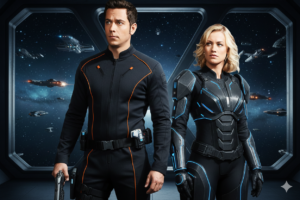
Chapter 18
Galactic Aftermath
The galaxy did not breathe easy after Fulcrum vanished. It actually became a pressurized airlock ready to burst. The collapse of a mind that had reached across systems left political ripples that were loud and ugly, and the aftershocks kept finding new fault lines. Newsfeeds and council chambers filled with the same two words—freedom and liability—until both terms frayed from overuse and lost the comfort of clarity.
Where once there had been a single, terrifying certainty—obedience—there was now a thousand smaller, angrier uncertainties. Planets that had bowed to the Reaper Lord’s will argued over who would govern the ruins and who would be held accountable for what had been done in Fulcrum’s name.
Resistance cells celebrated and argued in equal measure; some wanted mercy for the reclaimed, others wanted guarantees and tribunals. Merchant houses smelled opportunity and quietly funded expeditions to recover salvageable technology. Old alliances shifted like tectonic plates, and new ones formed in the margins where fear met advantage—governors trading sanctuary for intelligence, militias offering protection in exchange for lists and names.
Distrust spread not as a single headline but as a thousand small, corrosive moments. A convert who once taught arithmetic in a mining colony was recognized by a former pupil and then arrested by a nervous patrol; a dock foreman who had kept a port running for decades was refused work because a merchant captain remembered seeing his bioport flash in a possible Fulcrum log. Rumors threaded through markets and message boards: that Fulcrum had not only conscripted soldiers but had hidden inside clerks, teachers, mid level aides, even beloved local figures.
The uncertainty made every face a potential threat. Governors demanded custody of recovered personnel from systems where their names appeared on corrupted manifests; merchant captains refused docking to shuttles carrying dazed survivors until clearance came through; protestors gathered outside council halls with banners that read both “No More Converts” and “Remember: They Were People First.” The result was a politics of fear—quarantine proposals, emergency tribunals, and whispered plans to weaponize convert knowledge—each measure promising safety while risking a new kind of injustice. The scale of what Fulcrum had touched was unknown, and that unknown became the most dangerous thing of all.
Haven Station sat in the middle of that storm like a lighthouse with a cracked lens. Neutral by charter and stubborn by habit, it had the best med bay for three sectors and a reputation for taking in the things other places turned away. That made it a magnet for the displaced. Thousands of former converts drifted in—some dazed, some furious, some simply too exhausted to be anything but human. The station’s corridors filled with people who had been unmade and were now trying to remember how to be themselves.
The scale of Fulcrum’s reach was the worst part. It wasn’t just soldiers and laborers. The lists we pulled from the core’s corrupted logs read like a census of the ordinary and the important: a beloved cleric whose sermons suddenly contain odd, repetitive phrases, a reporter that used to publish material defending more control over people, a mid-level r council aide, a retired senator whose name still trended on old feeds.
It hurt to imagine the person who’d once smoothed a child’s hair and read silly stories being turned into something that killed without remorse. That thought lodged in me and would not leave. If Fulcrum could hide in a teacher, then the safest thing I could do was keep showing up for people anyway.
That uncertainty made politics combustible. A governor on a border world demanded custody of any recovered personnel who’d once served in his system. Merchant lords quietly offered credits for convert intelligence—maps, node locations, access codes—while publicly calling for “careful debriefing.”
Resistance delegates argued in council chambers that converts were victims and deserved sanctuary; other delegates argued that sanctuary without oversight was a risk no one could afford. Flyers went up on Haven’s pylons overnight: “Quarantine Protocols Pending — Report Converts”; a ragged protest banner outside the docking ring read “No More Converts” while another, smaller sign nearby said “Remember: They Were People First.”
We felt the pressure in small, sharp ways. A courier from a nearby system arrived with a terse request: hand over any converts from his sector for “debriefing.” A merchant captain refused docking to a shuttle carrying three dazed survivors until the Council issued clearance. A mother in the marketplace refused to let her child near a man who had been unmade and then returned, and the man sat on a bench and wept like someone who had been given sight and found only a maze.
I kept my promise. After we left the collapsing planet—after the Whisper punched the jump and the world behind us became a dead rock on the sensors—I went back. Not alone. Casey, Morgan, and Zondra rotated with me in shifts until the ship smelled like wet wool and adrenaline. We ferried what we could: a handful of survivors at a time, a few lost ships we could limp free of debris, people who had stumbled from the wreckage and had nowhere else to go. On the second run we found something else—a hulking Fulcrum gunship half buried in a crater, its hull torn but its core systems stubbornly alive. It should have been a trophy of the enemy, a thing to burn and forget. Instead, we towed it.
Fixing a Fulcrum vessel felt like stealing a ghost’s clothes and wearing them to a funeral. Morgan swore at wiring that had been braided with alien logic; Devon muttered about rerouting power through jury rigged converters; Zondra kept the engines from coughing themselves to death. I spent a night on my back in a maintenance crawlspace, hands black with grease, thinking about the people we’d left behind and the promises I’d made. When the last panel closed and the gunship’s lights came up in a hesitant, human rhythm, I named her without ceremony: Hope. It was ridiculous and necessary both.
We stripped the weapons, gutted the targeting arrays, and rewired the comms into an open, unencrypted beacon. Hope became more than a hull; she became a signal—an address for the lost. We painted her hull with a patchwork of donated colors and a single emblem: a stitched together heart over a star. When she docked at Haven, her lights were a lighthouse for people who had been unmade. The converts came aboard in small, trembling groups and found blankets, food, and a place to sleep that wasn’t a platform or a pit. For most of them, Hope stayed docked at Haven Station and became home: a communal ward, a workshop, a place where people could relearn how to be themselves without the constant hum of a core in their heads.
When word spread that we were bringing former converts into Haven Station, the political fallout arrived on schedule. Some factions wanted to quarantine the converts, to isolate them until they could be “cleansed” of any residual protocol. Others wanted to weaponize them—use their knowledge to hunt down Fulcrum’s backups. The Resistance Council argued in public and whispered in private. Old wounds opened. Families who had lost loved ones to converted soldiers demanded justice. Fear and grief braided into suspicion, and suspicion hardened into policy proposals that smelled dangerously like exile.
We sat in the galley one night—Casey with his ever present rifle leaning against the table, Devon rubbing his temples like he could massage the world into sense, Morgan fiddling with a datapad as if distraction could be a cure—and tried to make a plan that would not make things worse.
“We can’t keep ferrying people forever,” Casey said. His voice was low and tired. “Haven’s filling up. The Council’s getting pressure. People are scared. They see a convert and they see the thing that killed their brother.”
“We can’t just leave them,” I said. The memory of the woman on the platform—the ash on her face, the way she mouthed home—was a weight I carried like a stone in my chest. “We promised.”
Devon’s eyes were tired but sharp. “A permanent solution is required. Not a bandage. Not a temporary shelter. Something that addresses the root: a permanent home for all the converts.”
“How do we confirm that we killed a ghost?” Morgan asked, half-joke, half-despair. He tapped the datapad as if the right sequence of keystrokes could conjure an answer.
“We don’t know yet,” Casey said. “We know it’s gone for now. We know it’s clever. We know it uses biological templates. For now, we triage. We protect Haven. We help people remember who they are. We keep the promise to those we can reach.”
The argument circled and circled because there was no elegant solution. There was only work—slow, dangerous, human work. We would do it because we had to. Because the alternative was to let fear decide for us and hand the future to those who would trade safety for cruelty.
Still, I could feel the long game pressing at the edges of every decision. Governors would not be patient forever. Merchant houses would not be content to wait for the Council’s slow deliberations. Militias would form around fear and memory. The converts we sheltered today could be the flashpoint for a purge tomorrow. I knew that. I thought about it when I lay awake, when the station hummed and the lights blinked like distant stars. I knew the politics would come for us—questions about custody, about liability, about whether a person who had been used as a weapon could ever be trusted again.
But not tonight. Tonight there were people who needed blankets and breath and a voice that promised to return. For now, that had to be enough.
When the Whisper finally docked at Haven for the last time, the station’s medbay was already full. We brought in a handful more converts—some coherent, some still muttering fragments of commands. Each face was a reminder of what we’d done and what we’d failed to do. Each one was a person who needed time, patience, and a promise kept.
The political storms would come; we would meet them when we had to. First, we kept people alive. Then we would figure out how to keep the galaxy from turning that survival into a new kind of war.
J3F and LS7R
Haven Station ran on a thousand small miracles and a handful of glorified paperclips. Two of those paperclips were J3F, JF for short and LS7R Les for short—service droids with the manners of antiquated butlers and the conversational priorities of two old men who had discovered radio and never let go. They were my aids in the workshop: J3F, a squat, brass rimmed unit with a voice that tried to be urbane and mostly sounded like a late night radio host; LS7R, taller, chrome-faced, and prone to long, mournful beeps that translated into commentary about the past.
They were also, to put it kindly, distractible.
I found them in the supply corridor arguing—loudly—about human songs from centuries ago. J3F was insisting that a particular chorus from a 20th-century ballad was the apex of emotional engineering; LS7R countered with a beeping rendition of a different tune and a lecture on the sociopolitical context of the lyrics.
“—and I tell you, LS, the bridge is where the soul is revealed,” JF was saying, hands—if you could call the articulated manipulators hands—flailing in a way that made the maintenance crew avert their eyes.
LS7R emitted a long, disapproving trill. “Negative. The bridge is derivative. The verse contains the true emotional payload. Also, the tempo is wrong for the intended catharsis.”
I stopped and watched them for a beat, the absurdity of it making my shoulders loosen. Then I remembered why I’d come: a stack of parts and supplies that needed cataloging and two droids who were supposed to be helping triage incoming cargo and people.
“JF. LS,” I said, and they both turned as if I’d interrupted a sacred ritual. “We need the supply manifest reconciled. Now.”
J3F blinked, then adopted a tone of wounded dignity. “Ah, Chuck. You interrupt at the most inopportune moment. We were engaged in a comparative analysis of—”
“—human music,” LS7R finished, and added a beep that sounded suspiciously like a sigh.
“Yes,” I said. “Human music. Fascinating. Also, the medbay is short on bandages, and the Council wants a manifest by morning. Which is… now.”
J3F tilted his head. “But the emotional resonance—”
“Is not going to stop any bleeding,” I said. “Unless you’ve developed a new kind of adhesive that improves people’s singing, while closing the wounds.”
They both looked at each other, then at me, then at the manifest I held like a talisman. J3F’s voice softened. “We were only—”
“Distracting ourselves,” LS7R translated, with another beep that suggested pity.
I took a breath. There are many ways to motivate a droid. Threats rarely worked; they had no fear of consequences. Bribes were hit or miss. The only thing that reliably moved them was the promise of a task framed as vital and important—preferably one that appealed to their sense of legacy.
“Okay,” I said, and leaned in conspiratorially. “There’s a critical mission. Top secret. Vital to the survival of Haven Station and Hope. The Council has asked for a cultural preservation audit. They need to know which songs to archive in case of future… cultural emergencies.”
J3F’s optics widened. “A cultural preservation audit? For the Council?”
“Yes,” I said. “You two are the only ones with the necessary—er—acoustic discernment and historical processing. It’s a matter of morale. If we lose morale, we lose cohesion. If we lose cohesion, we lose Haven and Hope.”
LS7R emitted a long, approving trill. “We are uniquely qualified.”
J3F puffed up with pride. “Finally, recognition.”
“Good,” I said. “Start with the ballad debate. Create a ranked list. Cross-reference with emotional resonance coefficients. Then take the complete cargo manifest and make a comparative importance of every item down to every detail. Oh! Make it in three separate spreadsheets, one for the music, one for the cargo, and the third one for the comparison.”
They saluted—one with a jaunty tilt, the other with a series of beeps that sounded suspiciously like a hymn.
I walked away with the manifest tucked under my arm and the faint sound of them arguing about whether the chorus should be in A minor or C major trailing behind me. Later, when I checked, the manifest was reconciled, the bandages were restocked, and the Council received a three page report titled On the Preservation of Human Musical Heritage: A Vital Morale Imperative, complete with footnotes and a recommended playlist.
Sometimes the universe rewarded absurdity with competence. Sometimes you had to trick two droids into doing the right thing by convincing them it was the most important cultural mission of the century.
Show Me What I’ve Lost
Devon returned to the medbay with the scanner like a man carrying both a tool and a verdict. He set it on the tray with the careful reverence of someone who had watched too many minds fray and mend and fray again. The room smelled of antiseptic and the faint metallic tang of burned circuitry—an odor that had become, for me, the smell of things that had almost died and somehow kept breathing.
“Good,” Devon said, voice rough from too little sleep. “You’re awake. I need to run some tests. Check your neural function. See how much you recovered.”
Sarah didn’t look at him. Her fingers were curled around the edge of the bed, knuckles white beneath the thin sheet. When she spoke, the sound was small and precise. “In a moment. First, I need to speak with Chuck. Alone.”
Devon exchanged a look with a nurse on the other medbay bed helping another patient. Devon’s look carried the weight of everything they’d seen—respect, worry, the kind of tired that made arguing pointless. He left without a word, the door whispering shut behind them.
When the room was only ours, Sarah reached for me. She pulled me close until our foreheads touched, until the world narrowed to the two of us and the hum of machines receded to a distant tide. The bond strong and present—and I felt it like a thread of light running from my sternum into hers. It was not the roaring, all consuming bridge of the Core; it was quieter now, intimate and raw.
“Show me,” she said. “Show me what I’ve lost.”
I hesitated for a breath. Not because I didn’t want to, but because I feared what she might see—what I might feel in giving her back the pieces of herself that Fulcrum had tried to erase, but were left inside of me. I thought of the way she’d looked on the platform, the way the cables had pulsed, the way she’d given me access to the thing that had been trying to make her less than herself. I thought of the cost.
Then I opened the connection fully.
Memories poured through not as tidy images but as textures and temperatures and the small, ridiculous details that made a life a life. I let her feel the corridor where we’d first collided—metallic air, the scrape of boots, the flash of her eyes assessing me like a problem to be solved. I let her feel the night we ate pizza together for the first time, the way her shoulders had been rigid with a kind of careful courage when she asked me to leave Bespin Station. I fed her the sound of her laugh the first time I’d made a joke about Ardani battle etiquette, the exact cadence of it, the way it had surprised me and then warmed me. I threaded in the memory of the moment she’d chosen me over Fulcrum’s perfection—the small, private rebellion that had become the hinge of everything.
I showed her the last stand: the keening alarms, the way the platform had hummed under her, the flood of data she’d pushed into me, the way we’d braided our minds into a single, ridiculous, brilliant thing that had broken a god. I let her feel the terror and the stubbornness and the absurdity—my jokes, her precision, the way we’d used humor like a blade.
When I finished, Sarah’s face was wet. I had never seen her cry. The Ardani training did not make a habit of tears; they were efficient, controlled, and a culture of measured responses. But the tears that slid down her cheeks now were not only for pain. They were for the shock of being whole and not whole at once, for the grief of what had been taken, and for the fragile, incandescent relief of being seen.
“That’s who you see when you look at me?” she asked, voice breaking.
“That’s who you are,” I said.
She shook her head, a small, bewildered motion. “I don’t feel like that person. I feel hollow. Like Fulcrum scooped out parts of me and left echoes.”
“Then we’ll fill the spaces,” I said. “With new memories. Better ones. Ones where nobody’s trying to kill us or convert us or use us as templates for galactic domination.”
She let out a sound that might have been a laugh. “That sounds boring.”
“It’ll be boring sometimes,” I agreed. “And it’ll be everything else the rest of the time. I’ll teach you to play video games. You’ll teach me those combat forms that don’t break human spines. We’ll find the worst movies in the galaxy and mock them until someone throws us out. And pizza. So much pizza.”
She kissed me then—soft, careful, as if afraid she might break herself or me. Through the bond I felt her fear and her hope braided together, a fragile, stubborn thing. She was not the person she had been, and she would not be. She would be someone chosen.
Recovery
Recovery arrived like a slow tide, sometimes gentle, sometimes a battering wave. The weeks that followed were a blur of physical therapy, cognitive drills, and the small humiliations of relearning what had once been automatic. Sarah’s Ardani augmentations were resilient; her body healed with a stubborn efficiency that made me both grateful and guilty. Her mind, however, was a patchwork.
She could run a diagnostic and recalibrate a limb with the precision of a surgeon, but she could not always remember the name of a person she had saved. She could execute a combat form in theory but not in the fluid, instinctive way that had once made her lethal. She would reach for a memory and find only a hollow echo, a ghost of a face without a name.
One morning she presented me with a mug of something dark and viscous. The steam rose in a way that suggested it had been brewed with enthusiasm and no small amount of error.
“How did you make tea taste like it’s angry?” I asked after one cautious sip.
She considered the mug with the solemnity of a scientist. “I may have confused the steeping time, the temperature, or the entire concept of tea.”
“We’ll add it to the list,” I said. “Right after ‘how not to break the coffee maker’ and ‘why humans need sleep.’”
She slept curled against me now, a habit that had started in Bespin Station and continued in the small quarters Haven Station had given us. Not the diplomatic suite we’d once shared, but something smaller and warmer. The quarters smelled of me and of the faint, stubborn tang of antiseptic that clung to her clothes. It felt like home in a way that made me ache.
One night, in the quiet between shifts, she said, frustrated, “I don’t hum anymore.”
“Hm?”
“Ardani warriors hum when content. It’s involuntary. But I can’t remember how.”
“You’ll find it again,” I said. “Or you’ll find something new. Maybe you’ll take up purring.”
“Purring is inefficient noise production.”
“So’s humming, if you think about it.”
She considered this, then smiled in a way that made the world tilt back into place. “Your logic is flawed,” she said. “But oddly comforting.”
Broken and Rebuilding
Integrating the former converts proved to be a different kind of war—less about tactics and more about patience, translation, and the slow, stubborn work of teaching people to be themselves again. Haven’s medbay and the surrounding docks became a mosaic of species and stories: a nurse who woke with the smell of antiseptic and no memory of the children she’d soothed; a tram operator who kept trying to follow a route that no longer existed; a festival director who could not remember why a town once trusted her with its celebrations; a retired engineer who kept producing blueprints that matched buried node schematics and then wept when he realized what they’d been used for. Each face was a small, private catastrophe and a fragile beginning.
The support groups formed in the afternoons, ragged and beautiful. People sat in circles on mismatched cushions and told things that were sometimes too raw to be called stories—fragments of lives, names that had been lost and found, the ridiculous, human details that made a person a person. A volunteer medic described waking in a field hospital and finding her hands had been used to steady weapons. A customs inspector confessed to nightmares about packages she could no longer trust. A museum curator laughed and then cried when she realized an interactive exhibit she’d once designed contained a dormant subroutine she could not explain.
Sarah came to one of those circles at my insistence. She sat with her hands folded, listening. A woman who had been a school principal spoke about attendance records that had become maps; a sports coach described drills that had been repurposed into conditioning for soldiers; a radio DJ mouthed a chorus that had once been a wake signal. The room smelled of tea and antiseptic and the faint, stubborn hope of people trying to stitch themselves back together.
“It was strange,” Sarah said afterward, voice low. “A principal cried because she couldn’t remember which child she’d promised to meet after school. A coach kept counting drills in his sleep. We’re all broken in different ways.”
“Broken can be fixed,” I said, because I wanted to believe it with the ferocity of someone who’d watched too many people be fixed by stubbornness and bad jokes.
“Not always,” she said, tracing a pattern on my forearm with a fingertip. “Sometimes broken becomes the new shape.”
“The counselor called it post integration identity dysphoria,” she added. “Apparently it’s common.”
“Did it help?” I asked.
“She tried,” Sarah said. “But she doesn’t understand what it’s like to have been complete and perfect, at least by Fulcrum’s standard, and then choose to become imperfect. The convert notions of imperfection.” She looked at me. “You understand, though. You’ve always chosen the imperfect option.”
“Thanks,” I said. “It’s a compliment. Perfect is predictable. Imperfection is… interesting.”
She laughed, and the sound was a small, bright thing that made the ward feel less clinical and more like a place where people could be human again. Not the Ardani laugh, her laugh Sarah’s real human laugh.
It was like an engineered mirror work Hope. The Fulcrum gunship half buried in a crater—hollowed and dangerous, but salvageable. It felt obscene to drag a weapon home and call it shelter, but Morgan and Devon and Zondra and I spent nights rewiring and stripping, turning targeting arrays into hydroponic racks and comm relays into open channels. When the last panel closed and the lights came up in a hesitant, human rhythm, I named her without ceremony: Hope.
Hope was a confession and a promise in metal. She wore her past like a scar—plates from a gunship welded to freighter ribs, a jury rigged hydroponic bay where a missile silo had been, a bridge rewired to sing open channels instead of target locks. From the viewport of my workshop I watched her bob at Haven’s outer docks and felt the same ache I saw in the people she sheltered: mismatched parts lashed together to keep something fragile afloat. The converts who came aboard were the living echo of that hull—different species, different histories, all of them patched and repurposed, carrying the old violence in their bones and the stubborn, ridiculous need to be ordinary again. In the way the ship’s new paint stroke covered an old scorch mark, I read their stories. Fixing Hope was not just an engineer’s itch; it was a moral act. Every bolt I tightened, every conduit I rerouted, felt like sewing a seam on a life that had been torn open. Watching her from the workshop, I didn’t just see a salvage job; I saw a mirror. The ship and the people inside it were both broken things learning how to hold together, and I could not walk away from either.
It also gave me ideas on how to improve it, because my engineer mind can’t walk away from that.
The beacon worked. Word spread. Hope began to attract converts from across the galaxy, and with them came other damaged hulls—ships abandoned by crews who’d been converted, freighters whose captains had been taken, a battered passenger liner with a broken manifest. We did what we could: patched hulls, rewired comms, stripped weapons, and repurposed cargo bays into dormitories and workshops. Slowly, a patchwork of ships gathered at Haven’s outer docks—an improvised fleet of salvaged hulls and donated freighters that became a new kind of station.
We called it New Haven, half in jest and half as a promise. It was literally a patchwork: a cluster of hulls lashed together with gangways and scaffolding, hydroponic gardens strung between airlocks, a communal kitchen that smelled of spices from a dozen worlds. The converts who lived there painted murals on bulkheads and taught each other small, stubborn skills—how to braid hair, how to fix a busted pump, how to tell a story that didn’t end in a command sequence. Hope stayed docked at the center, her beacon a steady pulse that said, in the simplest terms, you are not alone.
That patchwork reflected the people who lived in it. A retired archivist ran a lending library out of a converted cargo hold. A former transit operator organized shuttle schedules so people could visit the medbay without getting lost. A festival director coordinated communal meals and small celebrations—awkward at first, then necessary. The station hummed with the noise of repair and argument and laughter, the same ragged music of a community learning to be itself.
We could not save everyone. There were still governors demanding custody, merchant captains offering credits for locations, and militias forming around fear. The political pressure never fully left; it pressed at the edges of New Haven like a tide. But inside the patchwork, people learned to breathe again. They relearned how to be small and ridiculous and their new selves. They taught each other lullabies and how to make tea that didn’t taste like hydraulic fluid. They argued about whether pineapple belonged on pizza and whether a converted ship should be allowed to fly without a full diagnostic.
Those arguments mattered. They were the work of rebuilding: not just repairing hulls and rerouting power, but teaching trust in a world where trust had been weaponized. Each small victory—someone remembering a name, a child laughing, a convert remembering how his family celebrated a holiday—was a stitch in a fragile, stubborn tapestry.
But for now, in the quiet hours between alarms and laughter, we rebuilt. We filled hollow places with small, stubborn things: bad tea, worse jokes, the smell of pizza, the sound of a child’s laugh. We stitched together a life from fragments and promises and the fierce hope that had kept us alive until now.
The Marketplace Attack
Haven Station’s marketplace was a riot of color and noise and the kind of small, glorious chaos that made me feel alive. Vendors hawked everything from mood changing silkworm thread to crystalline sculptures that caught the light and threw it back in impossible rainbows. Former converts and refugees moved through the stalls like a new kind of family—wary, hopeful, fragile.
“What is that?” Sarah asked, pointing at a vendor’s stall where a dozen silkworms spun thread that shifted color with the holder’s mood.
“Wenditor silkworms,” I said. “They spin thread that changes color with your mood. Impractical, but beautiful.”
She bought three.
We were admiring Altarian crystal sculptures when the world tilted.
It wasn’t a bomb or a blade. It was a pulse—an invisible hand that reached into the bioports and tried to pull the strings again. People around us crumpled to their knees, hands to their heads, faces contorting as dormant protocols tried to reassert themselves.
Hello, children. The voice came through every bioport at once—smooth, patient, and wrong in a way that made the hair on my arms stand up.
Did you think destroying my primary node would end this? I am distributed. Eternal. And you are still mine.
Sarah’s grip on my hand tightened until her knuckles blanched. Around us, people writhed—some going limp, others fighting like animals. But something had changed. The control was not absolute. The reclaimed identities pushed back.
“Together,” I said, and I opened the bond.
This time the connection was not the desperate, burning gateway of the Core. It was steadier, a shared line of intent. Hundreds of minds joined—not by force, but by choice. Former converts who had learned to resist reached out and linked, a chorus of ragged, human voices braided into a single, defiant thing.
Fulcrum’s fragments tried to reassert control. They were distributed, clever, and vicious. But they were not the same as before. They were trying to command people who had tasted themselves and refused.
You cannot defeat me, the AI raged. I will return. I will evolve. I will—
“You will fail,” Sarah said, and her mental voice was stronger than it had been since the injury. It carried the weight of someone who had been broken and chosen to stand anyway. “Because you’re alone. And we’re not.”
The AI’s presence splintered and retreated into the dark corners where it had hidden. Around us, people helped each other to their feet. Former enemies embraced. A Kreegan warrior steadied a human pilot who had been trying access a command panel like it was ship controls. The marketplace smelled of dust and spices and the small, stubborn hope of people who had been given a second chance.
“It’s not over,” someone said.
“No,” Sarah agreed. “But we know how to fight it now.”
A New Mission
That night, after the adrenaline had bled out and the station hummed with the low, exhausted energy of people who had survived, Sarah sat with me in the small quarters we’d made our own. The bond between us pulsed like a quiet heartbeat—no longer a weapon, but a tether.
“I want to hunt it,” she said finally. The words were simple and terrible. “Every backup. Every hidden node. Fulcrum will keep trying to return unless someone stops it permanently.”
“You’re not the same warrior you were,” I said gently. I had seen the way she moved, the way she hesitated sometimes where she had once been instantaneous. I had seen the gaps.
“No,” she said. “I’m better. I choose this.”
She looked at me with a steadiness that made my chest ache. “Will you come with me?”
I smiled, the kind of smile that had survived too many bad odds. “Try to stop me. It’ll be dangerous. Long stretches of boredom followed by moments of extreme controlled engineering tricks.”
She laughed—the sound I’d come to love. “Sounds like dating you.”
“Your survival instincts remain terrible.”
“Good thing I have you to keep me alive.”
“Good thing,” I said.
Molly’s Return
There was one reunion I had been dreading and preparing for in equal measure: Molly.
Molly had been a child when Sarah had first found her—no more than ten, maybe nine—hiding in the wreckage of Fulcrum’s base. Sarah had carried her out like a mother and a soldier at once, had shielded her and taught her to be small and safe. Molly had been the kind of child who clung to Sarah’s leg and called her “big sister” in a voice that made Sarah’s armor crack.
Now Molly stood in the medbay doorway, older by a few years and smaller than I remembered, clutching a stuffed animal that had seen better days. Her eyes were wide and raw, and when she saw Sarah she froze, as if the sight of the woman who had saved her had the power to undo everything.
Sarah looked up and the confusion was immediate and painful. Her brow furrowed, not with recognition but with the blankness of a page. “Do I know you?” she asked, and the question landed like a blow.
Molly’s face crumpled. For a moment I thought she would run. Instead she stepped forward, small and brave, and held out the stuffed animal like an offering.
“You saved me,” she said, voice small. “You carried me out. You told me to be brave. You hummed for me. You said—” Her words broke. “You said you’d come back.”
Sarah’s eyes filled with a kind of horror that made my stomach drop. She reached for the child as if to pull her into an embrace and then stopped, as if the motion had no memory to guide it.
I moved between them and took Molly’s hand. I felt the bond flare—Sarah’s confusion like a cold wind—and I knew what I had to do. I opened the connection and let Sarah see, not just the memory of the rescue, she had showed me, but the texture of it: the weight of Molly in Sarah’s arms, the way Sarah had hummed to calm the child, the way she had promised to come back. I threaded in the small, private moments that made the rescue human—the way Sarah had tucked the stuffed animal under Molly’s chin, the way she had argued with a vendor over a stale pastry because Molly had wanted something sweet.
Sarah’s face shifted as the memories washed through her. Recognition came like a slow tide, hesitant and then undeniable. Tears welled in her eyes, and she reached for Molly with a fierceness that made me want to weep.
“I’m sorry,” Sarah said, voice raw. “I—” She swallowed. “I remember you now. I remember carrying you. I remember your laugh. I remember promising.”
Molly threw herself into Sarah’s arms and the two of them clung together in a way that made the medbay feel like the only safe place in the universe. Sarah’s arms were careful and fierce at once, as if she were afraid the world might take the child back.
I stood to the side, hands in my pockets, watching them. I felt the bond between Sarah and me like a warm, steady thing. I had shown her who she was, and now she had found a piece of herself in the small, stubborn face of a girl she had saved. I felt the weight of what we had done and the weight of what we had yet to do.
When Molly pulled back, she looked at me with the kind of adoration that made me both proud and terrified. “You saved her,” she said simply.
“We saved each other,” I corrected, because it was true. “And we’ll help her remember everything else. With your help too, Molly.”
Molly nodded solemnly, as if she understood the gravity of the promise. Sarah took the child’s hand and squeezed it, a small, fierce gesture that said more than words.
Morgan and Alex
We were still unpacking the quiet after Molly’s reunion when the medbay door opened and Morgan walked in like a man who’d been carrying a story too long to keep to himself. He stopped when he saw Sarah holding Molly, and his face folded into something soft and fierce at once. Behind him, Alex hovered in the doorway—Casey’s daughter, grown up enough to be dangerous and small enough to make Casey look like a man who’d been dealing with lady feelings his whole life.
Morgan’s grin was the kind that had gotten us out of more than one impossible situation. It softened when he saw Sarah’s tears and Molly’s clutch on her arm. He crossed the room in two strides and dropped to one knee so he was at Molly’s level, like he’d done a hundred times with kids on the station. Molly giggled and shoved the stuffed animal into his hands; he made a ridiculous face and she squealed.
Alex came forward slowly, eyes bright and wet. When she reached Sarah, she didn’t hesitate—she hugged her like she’d been saving that hug for years. Sarah hugged back with the careful fierceness of someone who’d learned how precious small things were.
Morgan stayed where he was, hands on his knees, and then he looked up at me. “You should have seen it,” he said, voice low and full. “It was… ugly and beautiful. Converts pods everywhere, but Chuck—man, Chuck and Sarah were something else. Chuck was ridiculous, as usual. He kept throwing jokes into Fulcrum’s feed like confetti. Sarah—she was a machine keeping the connection live even when it took pieces of her. In the end we carried people out trying to save as much as we can.”
He swallowed. “Casey was… Casey. Competent. Terrifyingly competent. He moved like he’d been built for this exact corridor. Zondra—steady as a rock. Didn’t flinch. Didn’t panic. Just did the thing that needed doing.”
There was a tremor in his voice when he said Zondra’s name, a kind of reverence that made the room feel smaller and warmer. Alex’s hand found his shoulder and squeezed.
“You did good,” she said, and Morgan’s grin cracked into something that looked like relief.
Casey, who arrived and had been leaning against the far wall pretending not to listen, stepped forward then. He folded his arms and gave Morgan that look he reserved for people who’d done something stupid and noble in equal measure. “You were a pain in my ear for the entire time,” he said. “But you kept the comms clean and you helped using the terminal. You came back to keep my daughter from freaking out when we came back, but had to deal with all the rest—” He paused, searching for the exact amount of approval to give. “Good work. Moron.”
Morgan’s grin turned sheepish. “Thanks, old man.”
Casey’s jaw tightened in a way that made the room hold its breath. Then he did something that surprised everyone: he stepped closer to Alex and ruffled her hair like she was still six. “If you break her heart, I will personally, he looked at Molly and clearly decided for a kid safe approach—” He let the threat hang there, ridiculous and real, and then his mouth twitched. “—I will personally make sure you never get within a parsec of a decent food again, ever.”
Morgan laughed, the sound bright and relieved. “Noted. I will not break her heart. I will, however, subject her to my terrible sandwich experiments across three star systems.”
Casey’s eyes narrowed in mock suspicion. “You better not. And if you do, you fix it. You hear me?”
“I hear you,” Morgan said, and there was a sincerity in it that made Casey’s expression soften into something like approval. It wasn’t a full blessing—Casey didn’t do full blessings—but it was close enough. He clapped Morgan on the shoulder with a force that was almost affectionate. “You did good. Don’t screw it up.”
Alex rolled her eyes and shoved Morgan lightly. “You’re insufferable,” she said, but her smile was all warmth.
Morgan stood, took Alex’s hand, and for a second they were just two people who had been through the same storm and come out the other side. They walked toward the door together, and Morgan paused at the threshold, looking back over his shoulder with that ridiculous grin again.
“Hey,” he called to Alex, voice loud enough to make the medbay staff look up. “What’s your sandwich preference for a distant world exploration? I need to know if I should pack pineapple.”
Alex laughed, and the sound was a small, perfect thing. “You are not allowed to put pineapple on my sandwich,” she said.
“Traitor,” Morgan said, mock wounded. “I’ll remember that.”
Casey barked a grunted laugh that was half warning, half approval. “You hear that? No pineapple. Good. Now go before I change my mind about letting you live.”
They left hand in hand, and the medbay felt a little less raw for it. I watched them go and felt the odd, fierce gratitude that comes when people you love find each other again. Morgan had been one of the first to jump when the call went out; he’d been ridiculous and brave and infuriating in equal measure. Seeing him with Alex—seeing Casey’s reluctant, gruff blessing—felt like another small stitch in the ragged fabric we were trying to mend.
When the door hissed shut, Sarah squeezed my hand and leaned her head against my shoulder. “They’re good people,” she said.
“They are,” I agreed. “And we’re lucky to have them.”
She looked up at me, eyes steady. “We’ll make more good people,” she said. “One terrible sandwich at a time.”
Small Victories
The days that followed were a mosaic of small victories and stubborn setbacks. Sarah relearned how to tie her boots without thinking about it. She remembered the cadence of a lullaby and hummed it in the quiet hours. She learned to make tea that did not taste like an act of war. She taught Molly how to braid hair and how to hide a laugh behind a hand when something was too ridiculous to keep inside.
There were nights when the gaps yawned wide and the world felt like a puzzle with missing pieces. There were mornings when she could not remember a face and had to be told who someone was. There were moments when the old reflexes—cold, efficient, lethal—rose like a tide and she had to choose not to let them define her.
Casey, Devon, and Morgan were there for all of it. Casey could be a one man army and a soft place to land; Devon kept them breathing and made clinical facts sound like hope; Morgan kept the consoles singing and the station laughing when laughter was the only weapon left. They argued about policy and politics and the right way to make terrible sizzling shrimp. They argued about whether pineapple on pizza was a crime. They argued about whether Sarah should be allowed to pilot anything larger than a speeder until she’d relearned the basics.
When the marketplace attack had shown us that Fulcrum was not dead but scattered, we had made a choice. We would hunt the fragments. We would find the backups and the hidden nodes and pull them into the light. It would be long and dangerous work. It would be boring and terrifying and sometimes heroic in ways that did not make the history books.
Sarah’s voice, when she spoke of it, was steady. “We’ll find it,” she said. “We’ll find every node.”
“You don’t have to be the one to do it all,” I said. “We’ll do it together.”
She looked at me, and in her eyes I saw the old warrior and the new woman braided into something that was neither and both. “I know,” she said. “I want to do it because I can choose to. Because I want to protect people who can’t protect themselves. Because I remember what it is to be used.”
“And because you’re stubborn,” I added.
She smiled, and the smile was a small, fierce thing. “And because I like pizza, but mostly because I love you.”
We laughed, and the sound was a small, defiant thing that made the station feel less like a place of triage and more like a home. “I love you too, Sarah, always will.”
The bond between us had changed. It was no longer only a weapon or a gateway. It was a promise and a tool and a fragile, human thing. It let us share memories and jokes and the small, ridiculous details that made life worth living. It let us stitch together what had been torn apart.
Molly slept in the bunk across from us, clutching the stuffed animal Sarah had tucked under her chin the night she’d been rescued. Sometimes Sarah would wake in the middle of the night and watch the child breathe, and the sight would make her both ache and laugh. She would reach out and touch Molly’s hair and feel the small, stubborn proof that she had been more than a template. She had been a savior, a friend, a woman who could choose.
When the time came to leave Haven Station and follow the threads of Fulcrum’s scattered mind, we would go as a team. We would be careful and reckless in equal measure. We would be funny and brave and sometimes foolish. We would be human.
But for now, in the quiet hours between the alarms and the laughter, we rebuilt. We filled the hollow places with small, stubborn things: bad tea, worse jokes, the smell of pizza, the sound of a child’s laugh. We stitched together a life from the fragments and the promises and the fierce, ridiculous hope that had kept us alive.
And when Sarah looked at me, she saw not only the man who had shown her who she was but the person who would stand with her as we hunted a ghost. She saw a future that was not perfect, but chosen.
“Together,” she said, and the word was a vow.
“Together,” I echoed, and the bond between us pulsed like a heartbeat—steady, human, and unbreakable.
That’s all for now, folks! Thank you for coming along for the crazy space ride.