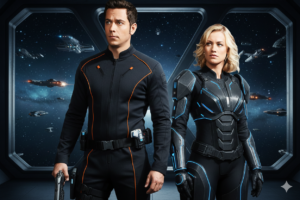
Chapter 6
We ran into two more Kreegan patrols on the way to the control center. The first hit us in a junction where the corridor narrowed and the emergency lights threw everything into hard, clinical contrast. Sarah moved before I could finish the thought of retreat—no flourish, no preening, only the economy of motion that comes from a lifetime of practice. Her blade flashed like a silver promise and the first Kreegan folded in on itself, a dark bloom of ichor staining the polymer floor. The second came faster, a blur of chitin and mandibles, and she met it with a pivot so small it might have been a twitch. The blade found a seam in the creature’s armor and split it open like a seamstress parting fabric.
In the last corridor before the control room, I did a small, stupid thing—the sort engineers do when terrified and clever in equal measure. A Kreegan had dropped from the ceiling—one of those ambushes they favored, using the maintenance rails to hide and strike. It launched like a spear, mandibles spread, aimed straight for Sarah’s throat. She didn’t see it until the last fraction of a second; her eyes widened, the blade arcing too late.
I had a maintenance panel open at my hip, tools in hand, trying to coax a stubborn conduit back to life to stop the light flickering. Instinct did the rest. I slammed the panel shut and yanked the emergency actuator lever with both hands. The hatch above the rail slammed down with a pneumatic roar, catching the Kreegan mid leap and sending it cartwheeling into the corridor wall. The startled service drone—one of the older models that still patrolled maintenance shafts—spun into the creature a heartbeat later, clipping it and sending it skidding across the floor.
That split second of chaos was all she needed. She twisted, blade finding purchase, and the Kreegan’s momentum worked against it. But the hatch hadn’t closed cleanly; a shard of composite sheared off and struck me across the forearm. I felt the hot sting and tasted metal in my mouth. I remember thinking, absurdly, that the pain was a small price for not watching her die.
I pressed my hand to the wound, felt the warm slick of blood, and forced my training into action—pressure, elevation, quick seal. Morgan’s voice in my head: field dressing first, heroics later. I tore a strip from my sleeve, wrapped it tight, and jammed a small cauterizer from my kit against the edge to stop the worst of the bleeding. It burned like a brand, but it worked. The bandage was ugly and temporary; the arm throbbed, a steady reminder that I’d been hit. I kept it wrapped as we moved—stiff, sore, and very much alive.
She looked at me then—eyes wide, breath coming hard—and for a second the Walker Blade was just Sarah. The predator mask slipped. Her fingers trembled when she reached for my arm; the gratitude there was raw and immediate. “You saved my life in the corridor,” she said later, but in that moment she didn’t need words. The pressure of her hand on my bandaged forearm said it all.
That memory sat under everything that followed. It was a ledger entry I kept returning to: one life saved, one life owed. The metaphor nagged at me, but I let it be a ledger in my head and not the only way I measured what we did. It made the next fights feel heavier, yes, but it also made me more careful.
By the time we reached the heavy doors marking the life support hub, Sarah was leaving bloody handprints on the walls, her strength leaking out with every step. Her breathing had become a series of short, controlled pulls, like someone trying to keep a fragile machine from overheating. The augmentations along her forearms flickered and dimmed, little constellations going out one by one. I wanted to stop, to force her to rest, but the urgency in her eyes silenced me. She was running on sheer willpower now, and I knew better than to argue with that.
The doors were sealed, emergency lockdown engaged. Through the reinforced window, I could see shapes moving inside. Lots of them. Shadows shifting, claws glinting under the sterile light. The life support hub was a cathedral of pipes and vents, a lattice of polished conduits and glass that reflected the station’s emergency blue. Maintenance walkways crisscrossed the room like ribs; consoles blinked with diagnostic readouts. The Kreegans had turned the place into a hunting ground.
“Can you override?” she asked, voice tight but steady.
“Given time, yeah. But they’ll hear me working.” I’d memorized the hub’s emergency override during a previous maintenance run—an old habit of mine: learn the weak points before they break. That knowledge let me move faster than a stranger could.
“They will be occupied.” She checked her blade, tested her grip. Several of her bioports were dark now, systems failing as her body redirected resources to core functions. The faint hum of her augmentations was weaker than I’d ever heard it. The implants that had once made her a walking weapon were flickering like a dying constellation.
“Open the door, Chuck. Then stay clear.”
“You can’t take them all, not injured.”
“I am the Walker Blade,” she said simply. “I have taken more with less.”
Her words carried no arrogance, only fact. I knelt by the access panel and got to work. My fingers flew over the interface, bypassing security protocols with tricks that weren’t strictly legal but were definitely effective. The panel resisted at first, a stubborn little thing that spat back encrypted prompts and safety locks. I coaxed it with a mixture of brute force and finesse—an engineer’s lullaby of code and pressure.
“Got it,” I whispered. “On your mark.”
She pressed one hand to my shoulder, a brief contact that felt like farewell. Her palm was warm and sticky with blood; the pressure was light but deliberate, a small anchor in the storm.
“You saved my life in the corridor.”
“You saved mine first. Call it even.”
“Only in debt and payment.” She squeezed gently. “I will remember.”
Then she was through the door, moving like death given purpose.
What happened next was simultaneously the most beautiful and terrifying thing I’d ever witnessed. Injured. Outnumbered. Fighting in confined space against enemies literally built for killing. Sarah turned combat into art. She didn’t just fight. She danced.
The room was chaos of limbs and light. Kreegans moved with a jerky, insectile grace, their mandibles clicking like a metronome. Sarah used the room’s geometry—pipes, consoles, the lip of a maintenance hatch—to funnel attackers into kill zones. She pivoted on the balls of her feet, a small, efficient rotation that let her redirect force with minimal exertion. Her blade was a silver arc that painted the air with precision; when one Kreegan’s claw shattered it, she took its arm off at the joint and used the severed limb as a club. The sound of chitin against ceramic was a wet percussion that underscored the rhythm of the fight.
She read micro movements the way a chess player reads a board. A twitch of a mandible, a shift of weight—she anticipated and answered before the thought could form in my head. She exploited the Kreegans’ reliance on scent and vibration, striking in ways that masked her own presence. For a while it looked like she might simply carve a path through them, a single human hurricane in a room of smaller storms.
But there were too many, and she was too hurt. I watched her take hits that would have killed a regular human instantly. One blow to the ribs buckled her for a heartbeat; another tore through the ceramic plating on her shoulder, exposing braided conduits beneath. Her bioports flared desperately, trying to compensate for damage faster than it could be repaired. Sparks danced along the seams of her implants. She moved slower, the edges of her timing blunted by pain and blood loss. The mask of invulnerability she wore in battle cracked and revealed the raw human beneath.
I wanted to rush in. I wanted to throw myself into the fray and be useful in the only way I knew how—by being a distraction, by being a second pair of hands. But I also knew that my interference would be a liability. My hands were not trained to be blades; my body was not a weapon. My weapon was my mind, and in that room the only thing I could do that mattered was think.
That’s when I noticed the environmental controls. The Kreegans had been sabotaging them, but they hadn’t finished. The atmospheric processing system was still functional, just offline. The control bank sat like a sleeping beast in the corner, its diagnostic lights dark but its valves intact. A hundred little levers and vents promised leverage if you knew how to pull them. The vents were arranged in a way that let you change flow patterns with a few quick commands; the filters could be bypassed to alter gas composition. It was a dangerous idea, but it was an idea.
“Sarah!” I shouted. “Breathing mask, now!”
She didn’t question, just grabbed an emergency mask from the wall and slapped it over her face. The Kreegans, confused by the seemingly pointless action, hesitated. They were creatures of instinct and scent; the sight of a human calmly donning a mask did not compute with their hunting algorithms. That hesitation was all we needed.
I reversed the atmospheric flow and engaged the manual override I’d installed months ago for just this kind of emergency—an old hack that let me force a local composition dump without waiting for central authorization. The vents sang as the composition of the air changed; the hiss was like a held breath released. I dumped a controlled pulse of nitrogen into the room. Humans could survive brief oxygen deprivation; Kreegans, with their distributed respiratory systems, could not. The readouts spiked and fell, the oxygen percentage plummeting in a clean, clinical graph.
They started dropping within seconds, clutching at their spiracles as their bodies shut down. Limbs spasmed, claws scrabbled for purchase on the smooth floor, and then the room filled with the soft, final thud of bodies collapsing. Sarah stood among the falling bodies like a statue, chest heaving, mask fogging with each breath. Her blade hung at her side, slick with alien blood, and for a moment she looked less like a warrior and more like a survivor who had been given a reprieve.
When the last Kreegan stopped twitching, I restored normal atmosphere and rushed to her side.
“That was… creative,” she managed, pulling off the mask.
“I have my moments.”
I caught her as she swayed.
“Medical. Now. No arguments.”
“I do not take orders from—” She stopped, blinking rapidly. “Your face is multiplying.”
“That’s the blood loss talking. Come on.”
Combat Results
The room smelled of metallic tang and hot plastic. The Kreegans lay where they had fallen, a tangle of limbs and broken armor. Some were intact enough to be studied; others had been torn apart by the blunt, improvisational violence of the fight. Their chitinous plates were scored and cracked, mandibles fractured, internal organs exposed in a way that made the med tech in me wince. The floor was a map of the battle: streaks where bodies had slid, pools of ichor that reflected the emergency lights like dark, obscene mirrors.
Sarah’s blade had been reduced to a jagged stub. The ceramic plating along her forearm was shattered in places, and one of her shoulder conduits had been severed. Her augmentations had taken damage in a pattern that told a story: a concentrated strike to the left flank, a glancing blow across the chest, a direct hit to the right knee that had nearly taken her down. The bioports along her spine had flared and then gone dark in a sequence that matched the timeline of the fight. In short: she had been pushed to the edge and had kept going.
The environmental hack had worked, but it had consequences. Dumping nitrogen into a sealed room is a blunt instrument; it buys time but it also stresses systems and risks collateral damage. The vents would need cleaning, filters replaced, and the life support algorithms would have to be recalibrated. The Kreegans’ bodies would have to be disposed of carefully—biological contamination protocols, quarantine, the whole bureaucratic nightmare that follows any encounter with alien biology. We had won the fight, but the station would pay for it in hours of maintenance and the slow, grinding work of repair.
Security arrived moments after we exited the room. They moved with the practiced efficiency of people who had seen too much and learned to keep their faces neutral. They took in the carnage with professional appreciation, cataloguing wounds, photographing the scene, and marking bodies for removal. One of them muttered something in awe about the way Sarah had fought; another simply nodded and began sealing the room. The official reports would later call it a decisive engagement, a tactical victory that prevented a larger breach. They would not, however, capture the small, human details: the way Sarah’s hand trembled when she removed her mask, the way her breath came in shallow, ragged pulls, the way her eyes had gone glassy for a moment when the stimulants finally wore off.
The Walk to the Med Bay
Dragging Sarah down the corridor, I felt the weight of more than just her body. It was the weight of responsibility, of fear, of the realization that without her, I was hopelessly outmatched in this war. My arms burned, my lungs ached, but I refused to let go. The corridor seemed longer than it had been on the way in; every step echoed with the memory of the fight. The security team moved past us, weapons raised, eyes scanning the carnage she had left behind. I heard the soft clack of their boots, the low murmur of radios, the distant thump of a med cart being rolled into position.
Her head lolled against my shoulder, golden hair matted with sweat and blood. I remembered the first time I’d seen her fight—how untouchable she’d seemed, how invincible. Now, she was fragile in my arms, human in a way that terrified me. The augmentations that had once made her a myth were now a patchwork of failing lights and sparking conduits. A med tech took her from me with practiced hands, murmuring triage codes into a wrist console. They moved with the efficiency of people who had seen too much and learned to keep their faces neutral.
As I carried her, my mind ran a loop of calculations and memories. I counted steps, not because counting would help, but because it gave me something to do with my hands and my head. One step, two steps—how far to the med bay? How long before they could stabilize her? How many more Kreegan patrols were out there? The questions multiplied like a rash.
I thought about the things that had nothing to do with the fight: the way she laughed on rare occasions, the way she sharpened knives in the quiet hours, the way she’d once told me she didn’t like being called a hero. Those memories were small, human anchors that kept me from floating away into panic. I thought about the corridor where she’d saved me, the way she’d moved without thinking, the way she’d trusted me enough to ask for a mask and then trust me to do the rest.
I also thought about the ledger of debts. We traded lives like currency in this attack, and the ledger was always unbalanced. I had saved her once; she had saved me twice. The math of survival was ugly and imprecise, but it was honest. I felt the weight of that debt in my arms and in my chest.
Every time she shifted, a fresh stab of fear went through me. Her fingers twitched, and I would start, imagining the worst. Once, she murmured something that might have been a name or might have been a curse. Once, her hand found mine and squeezed, a small, human gesture that felt like a promise. I clung to that promise like a life raft.
As we neared the med bay, the pace of activity increased. Stretchers were being prepped, triage lights blinked, and the smell of antiseptic grew stronger. The med bay doors slid open with a pneumatic sigh and a team of med techs stepped forward. They took Sarah from me with practiced hands, murmuring triage codes into a wrist console. For a moment I felt useless, an extra weight that had to be set down.
“Name?” the lead tech asked, voice clipped.
“Sarah Walker,” I said. “Walker Blade. Ardani warrior.”
The tech’s eyes flicked to the implants, then back to me. “We’ll take it from here. You should get checked too.”
I nodded, but I didn’t move. I watched as they wheeled her away, the sheet pulled up to her chin like a small, fragile shield. The med bay smelled of antiseptic and warm metal. I sat on a folding chair in the corner, hands clasped so tightly my knuckles went white. My mind replayed every moment—the flash of her blade, the hiss of nitrogen, the way her hand had lingered on my shoulder like a promise.
Sitting there, waiting, I felt the victory as a physical thing: exhausted and raw. The station’s emergency lights had dimmed to a soft, exhausted glow. Outside the viewport, the black of space was a velvet so complete it felt like a presence. I thought about the people who had died in the corridors, the maintenance crews and security teams who had been caught in the crossfire. I thought about the Kreegans—what they were, what they wanted, and how many more of them there might be.
I realized then that survival wasn’t just about strength or skill. It was about trust. About knowing when to fight and when to rely on someone else. Sarah had trusted me, and I had trusted her. Together, we had won. But the victory felt fragile. Because the conflict probably wasn’t over. And next time, we might not be so lucky.
My thoughts kept returning to small, practical things—the repairs that would be needed in the life support hub, the reports that would be filed, the quarantine protocols that would have to be enforced. Those were the things that would keep the station running, the mundane scaffolding that made heroics possible. But beneath the logistics was a quieter truth: we had been given a reprieve, not a resolution. The Kreegans were still out there.
Excellent chapter- very exciting! I’m also glad Sarah is having some human-ish moments with Chuck.. he is really in over his head! 🙂