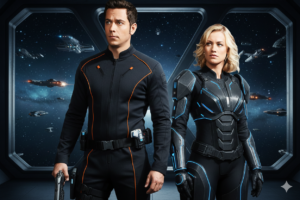
Chapter 7
The smell of antiseptic and hot metal of the med bay didn’t leave my nostrils, a sterile scent that tried and failed to erase the memory of blood and chitin. When they finally let me in, the room felt too small for everything that had happened there. Monitors blinked in slow, indifferent rhythms; tubing arced like pale veins; a bank of diagnostic holo screens cast a cool, clinical light over Sarah’s still form. She looked smaller without armor, the broad planes of her shoulders softened by a thin hospital gown. For a moment, the Walker Blade was only a woman breathing under a sheet, and the sight of her so ordinary and so vulnerable hit me harder than any of the fights had.
Her eyes opened when she heard my boots. They were unfocused at first, like someone surfacing from deep water, but when they found me the armor slipped for a breath. Fear lived there—not the sharpened, useful fear that made her a better fighter, but the kind that made her human: raw, immediate, and honest. “The attack was costly, we lost people,” she said, voice a rasp that carried more than exhaustion. “We can’t withstand another one like this.”
“We don’t have a choice,” I said. The words felt brittle in my mouth. They were true and useless at the same time. Outside the med bay, the station hummed on, indifferent and relentless. Inside, time had narrowed to the space between her breaths.
She closed her eyes and, for a second, I saw a child in the way her jaw unclenched. “My instructor taught me to sharpen knives,” she murmured. “He said a blade is only as good as the hand that holds it. I thought he meant technique. I understand now he meant responsibility.”
That line—simple, domestic, and brutal—hung in the air. It reframed everything. The fights, the blood, the ledger of debts we kept in our heads. It made the violence feel less like a spectacle and more like a series of obligations we could not refuse.
That conversation made me remember how we’ve reached the med bay in a blur. I remember the corridor as a tunnel of lights and the weight of Sarah’s body against my chest. Her hair was matted with sweat and blood; her breath came in shallow pulls. Security had cleared a path for us, their faces set in the neutral masks of people who had seen too much.
Still lifting the fog of memory, I remembered how Dr. Devon Woodcomb had approached me at the threshold, after the triage, he moved with the calm efficiency of someone who had been trained to make decisions under pressure.
Devon was not the kind of doctor who wasted words. He had a presence that filled the room without shouting—an easy competence that made people trust him before they even knew why. He took one look at Sarah and barked orders that turned the med bay into a choreography of purpose. “Trauma suite three. Get me a vascular line and a stabilizer. Prep the augment diagnostics.” His voice was precise, the kind of voice that could cut through panic and leave only action.
They laid her on the table and the med techs worked with practiced speed. I tried to explain what had happened—the nitrogen dump, the Kreegans, the way she’d kept fighting—but my words were unnecessary. Her wounds told the story better than I could. Devon listened to the monitors, his fingers moving over the holo readouts as if he were reading a language only he understood. He glanced at me once, a quick, assessing look that asked more than it said. “You did what you could,” he said. “Now step back.”
I stepped back because there was nothing else to do. Watching them work felt like watching a ritual I had no part in. The med techs removed shattered ceramic plating, cauterized ragged tissue, and threaded vascular lines with the kind of hands that had steadied themselves through years of trauma. Devon’s attention never left Sarah. He toggled between the physical and the digital—stitching flesh with one hand while running augment diagnostics with the other. When a conduit sparked, he didn’t flinch; he adjusted the power flow and kept going.
“Her bio integrated systems are stressed,” he said at one point, voice low enough that only I could hear. “We can stabilize, but the implants are finicky. If we push them too hard we risk systemic failure. If we don’t push, she won’t wake.”
“Which do we choose?” I asked, because asking felt like doing something.
“We choose the option that keeps her breathing,” Devon replied. “For now, that’s enough.”
There was a tenderness in his pragmatism that surprised me. He treated Sarah’s augmentations like a patient and a puzzle at once—respectful of the person and fascinated by the machine. It made him more than a background figure; it made him a guardian of the fragile bridge between flesh and technology.
Devon’s work was not only technical. He had a way of anchoring the room emotionally. When a med tech flinched at the sight of alien ichor, Devon’s voice was steady and human. “We honor the dead by saving the living,” he said once, and the sentence landed like a small benediction. He coordinated the triage team, delegated tasks, and kept the tempo steady. He also took time to explain things to me in a way that didn’t feel condescending.
“You did something clever with the atmosphere,” he said quietly, after the worst of the immediate crisis had passed. “Dumping nitrogen was risky, but it bought you time.” I answered: “It also stressed the vents and the filtration systems. We’ll need to run a full decontamination and recalibrate the life support algorithms. The Kreegan biomass is corrosive; it’ll eat through seals if we don’t act.” Repairs on the station, my engineer’s mind was the only thing working well right now.
“Devon do you think I did the right thing?” I asked, surprised at how much I wanted his approval.
Devon looked at me with a kind of clinical kindness. “You did what was necessary. That’s the metric we use in emergencies. Necessary, effective, and survivable. You passed.”
His approval felt like a small, private medal. It didn’t erase the fear or the exhaustion, but it made the ledger of debts feel less like a condemnation and more like a shared burden.
Devon also became the interpreter of Sarah’s body. He explained the diagnostics in plain language, translating the cold readouts into a narrative I could understand. “Her bioports are cycling at reduced capacity,” he said, tapping a holo. “We’ve put the augmentations into maintenance mode to prevent runaway feedback. The ceramic plating protecting the bioports is compromised in several places; we’ll need to replace it with composite grafts. She’s on a cocktail of stimulants to keep her cardiovascular system stable, but that’s a temporary measure.”
“Devon, I feel something strange, like a connection?” I asked because the memory of her hand on my shoulder and the way her fingers had lingered before I crouched to use the access panel had left something humming in the back of my mind.
Devon’s expression softened. “Augmented warriors sometimes have neural interfaces designed for combat. They’re meant to synchronize teams, share sensory input, and speed reaction times. The interface can share sensory impressions and embedded procedural memory when both parties consent and the channel deepens, but it does not automatically grant full access to another person’s thoughts or long term memories. If she initiated a link with you, it could be temporary—an emergency protocol—or it could be something else. We’ll know more when she’s awake and coherent.”
He said it like a scientist and a man who had seen too many human stories to be surprised by any of them. His presence made the med bay feel less like a place of triage and more like a place where decisions were made with both head and heart.
When they finally allowed me to sit with her, Sarah was awake but fragile. The monitors painted her in soft, pulsing light. Her augmentations glowed faintly along her body and spine, diagnostic readouts scrolling across a small holo above her wrist. She tried to sit and failed, a small, human sound escaping her lips. I pulled a chair close and watched her like someone watching a candle that might go out at any moment.
“You’re stubborn,” I said, because the old banter felt like a lifeline in a room that still smelled of antiseptic and burnt metal.
“You’re sentimental,” she replied, voice a rasp that still carried the edge of the woman who could cut a man in half with a thought.
“Fair,” I said, and the word landed between us like something fragile we were both trying not to drop.
“How was the damage to the station and the personnel?” she asked, and I told her what I knew while my mind kept returning to faces: the med tech whose hands trembled from too many hours, the security team with a new hollow under their eyes, the engineers who had rerouted life support and paid for it with exhaustion. The victory had been bought in small, private ways that wouldn’t make the reports—stitches, whispered reassurances, someone holding a flashlight while another slept for ten minutes in a chair.
“You’ll heal,” I said, because hope felt like the only currency I had to offer.
She smiled then, small and crooked, and for a second she looked younger than the armor and the scars allowed. “Maybe. Or maybe I’ll be a cautionary tale.”
“Not to me,” I said, and the words were steadier than I felt.
She reached for my hand and found it—cold at first from the med bay air, then warm and sure. Her fingers were callused and scarred; the grip was simple and electric, a human thing that made the rest of the room fall away. We sat like that, palms pressed, and let the silence hold the shape of what had been and what might have been: the narrow misses, the doors that had closed, the ones that had opened. In that quiet, thoughts moved between us without speech—what we had seen, what we had lost, and the small, dangerous possibility of what we might mean to each other if we let it.
Morgan’s survival
After the brief exchange, Sarah went back to sleep to heal. I was still sitting there when Morgan stumbled in, half supported by two med techs. A strip of gauze wrapped his head, and another bandage looped around his arm in a sloppy sling. He looked smaller than I remembered—paler, eyes rimmed red—but when he saw me, his face split into that ridiculous, relieved grin that had gotten him out of more trouble than it should have.
“Dude,” he said, voice thin. “You’re alive. You’re both alive.” He laughed, a sound that trembled on the edge of a sob. “I thought—man, I thought I was going to be the one who didn’t make it back. I hid behind a crate and then I helped pull people out and then I hid again. It was… awful. I was scared, Chuck. I was really scared.”
I pushed myself up and went to him before I could think. He flinched at my touch but didn’t pull away. Up close, the bandage at his temple was darker than it had looked from across the room.
“You okay?” I asked, because it felt like the only sensible question.
Morgan shrugged, which was to say he wasn’t okay, but he was functioning. “I’m patched. I’m patched and I’m loud and I’m probably going to complain about this for a week. But I’m here. And you—” He reached out and gripped my sleeve, hard. “You saved people tonight. You saved Sarah. You saved me. I thought I’d lost you, man. I thought—”
He stopped, the sentence collapsing into a breath. For a second, he looked like a kid again, the bravado gone. I didn’t have a speech ready, so I did the only thing that felt right: I pulled him into a quick, awkward hug. He smelled like antiseptic and fear and something else—relief, maybe.
“Glad you’re here,” I said. “Glad you made it.”
“Glad you made it more,” he shot back, voice thick. “Also—if you die on me now, I will haunt you. And I will make your ghost write my eulogy.”
I laughed, because Morgan’s threats were always better than silence. He managed a crooked smile and then, quieter: “Sarah—she was… insane. I’ve never seen anything like it. I was terrified, Chuck. But she was amazing. You two—don’t ever do that again, okay? Promise me.”
“Promise,” I said, and meant it, but I wasn’t sure I could deliver it.
He squeezed my hand once, then let go. “Now tell me where the coffee is. I need something that isn’t hospital sludge.” He tried to joke, and the joke landed because we both needed it to. Then his face sobered. “Seriously, though. Thanks. For everything.”
A med tech guided him toward a recovery bay for observation and stitches. As they led him away, he turned back once, eyes bright and earnest. “Take care of her, okay? And take care of yourself.” Then he was gone, leaving the room quieter in a different way.
Watching him be led away, something in me loosened. Morgan had been scared and he’d survived. So had Sarah. So had I. It didn’t fix anything, but it made the room feel less like a a med bay where life and death battles are fought and more like a place where people could come back from the edge.
The Interface and the Quiet Connection
Later, when the immediate chaos had settled and the med bay had quieted to a low hum, Sarah woke up again, this time a little more composed, less fragile-looking. She did something I hadn’t expected. She reached out and touched the back of my neck, her fingers careful and deliberate. The contact was light, almost reverent. For a moment, nothing happened. Then a warmth spread through me, not physical but cognitive—a faint echo of her heartbeat, a shimmer of pain, a ghost of awareness that felt like standing at the edge of someone else’s dream.
“What…” I started because words were the only way to anchor myself.
“Bio neural interface,” she said, voice soft. “A gift of the Walker Blade. It’s designed so Ardani warriors can fight as one—sharing instinct, pain, and awareness in battle. Linked minds move faster than any single fighter, anticipating threats before they strike. It makes us more than soldiers. It makes us a unit.”
The sensation was subtle but undeniable. I could feel the rhythm of her breath as if it were my own. I could sense the ache in her shoulder where a conduit had been severed. It was not full empathy; it was a thread, a shared channel that let two minds brush. When she pulled her hand back, the echo lingered like a scent.
“Is this permanent?” I asked.
“Only if fed,” she said. “Without intentional contact, it fades in days.” She hesitated, her eyes flicking away before returning to mine. “The first time… it was an accident. I didn’t know the interface could even respond to a non-Ardani. It shouldn’t have. But it did.”
I blinked, trying to process that. “So this—now—wasn’t an accident?”
Her jaw tightened, then softened. “No. This time it was my choice. A link I wanted to make. A link I want to keep.” She looked embarrassed by the intimacy of the admission, as if she had revealed something private. “I should not have done that. It is against the rules.”
“Since when do I care about rules?” I asked, because the old Sarah—sharp, guarded, lethal—was still there beneath the exhaustion.
Her lips curved in something between a smile and a grimace. “You, little engineer, are making me care about things I should not. You remind me I am more than what they built I’m more than a weapon, a warrior.”
For a heartbeat, she let the thought linger, and in the quiet hum of the med bay, she realized how alien it felt to admit it. More than a warrior. More than a weapon. The words echoed inside her like a forbidden mantra. For years, she had been trained to silence such notions, to bury softness beneath steel, to measure her worth only in kills and victories. Yet here, with warmth brushing against her through the link, she felt the edges of that conditioning fray.
Chuck didn’t hear the words themselves, but he felt the rush of her awareness through the bond—like currents of emotion breaking against him. A flicker of shame, the heavy weight of old obedience, then the fragile spark of hope. It wasn’t language, it was sensation: the ache of someone realizing they might be more than their scars, the tentative lift of breath that came with imagining a different self.
She thought of the operating where the bioports had been installed, of the endless drills that stripped away hesitation, of the instructors who told her compassion was weakness. And now, against all of that, she felt the pulse of his steadiness—coffee warmth, laughter, the stubborn insistence that she was not just a blade but a person. It unsettled her, but it also anchored her in a way doctrine never had.
If I am more than what they built, she wondered, then what am I allowed to become? The question was dangerous, but it carried a spark of hope she hadn’t dared to feel in years. Chuck felt that spark too, not as words but as a sudden brightness in his chest, a warmth that wasn’t his own but hers, shared through the fragile thread between them.
The connection changed the perception of the room. It made the monitors and the machines feel less like barriers and more like witnesses. It made the med techs’ movements seem like part of a larger choreography. And it made Chuck aware of how blurred the line between them had become.
Devon watched from across the room, his expression unreadable. When he approached, he did so with the same quiet competence he had shown all night. “If you two are experimenting with neural links,” he said, half joking, “keep it consensual and keep it brief. We have limited bandwidth on the augment stabilizers.”
His tone was light, but there was a gravity beneath it. He probably learned about what such links could change people—make the boundaries between self and other porous, sometimes dangerously so. He added, more softly, “If you choose to explore this, do it with care. These interfaces can heal, but they can also bind in ways that are hard to undo.”
Sarah’s gaze flicked to mine, then back to Devon. The bond carried her unease into me—fear of exposure, fear of doctrine. I felt it as a cold knot in my chest. I spoke before she could. “Devon… this stays between us. No one else. Not the Ardani. Not the staff. No reports.”
Sarah’s voice followed, low and firm. “It must remain secret. If they knew, they would strip it to rules or to fear. Promise us.”
Devon looked at us both, then at the monitors still pulsing with her vitals. He nodded once, solemn. “You have my word. Doctor patient confidentiality, and more than that—friendship. I’ll keep this between us.”
The bond hummed with relief, Sarah’s tension easing just enough for me to feel it. I let out a breath I hadn’t realized I was holding. Devon’s promise hung in the air like a seal, quiet but binding. Sarah went back to sleep.
The med bay hummed on, machines keeping time with the slow, steady rise and fall of Sarah’s chest. Outside, the station continued its work—repairs, reports, quarantine protocols—while inside we sat with the fragile, human thing that had grown between us: a connection that was equal parts risk and comfort, and now, unmistakably, a choice protected by a solemn vow.
I sighed, feeling the weight of that warning, what happened, and what the future holds.